
If you are a homeowner with access to water You’ve probably thought of Floating or Fixed at least once when weighing the alternatives. I’ve been there too. The reality is quite simple. Water is moving. The demands of your customers evolve. Budgets are flexible. Here at Supreme Floating Docks, we strive to make the decision slower by a bit so that you can discern the pros and cons before moving quickly after you have made the right choice. This guide outlines the major three options, and includes few notes on the field and provides a brief checklist that you could utilize after closing the tab.
What Are The Floating Dock Vs Fixed Dock Pros And Cons In Plain Language?
Start by observing how the site performs during an up-and-down weekend, not on a peaceful Tuesday. This headspace allows Floating or Fixed more attainable to evaluate.
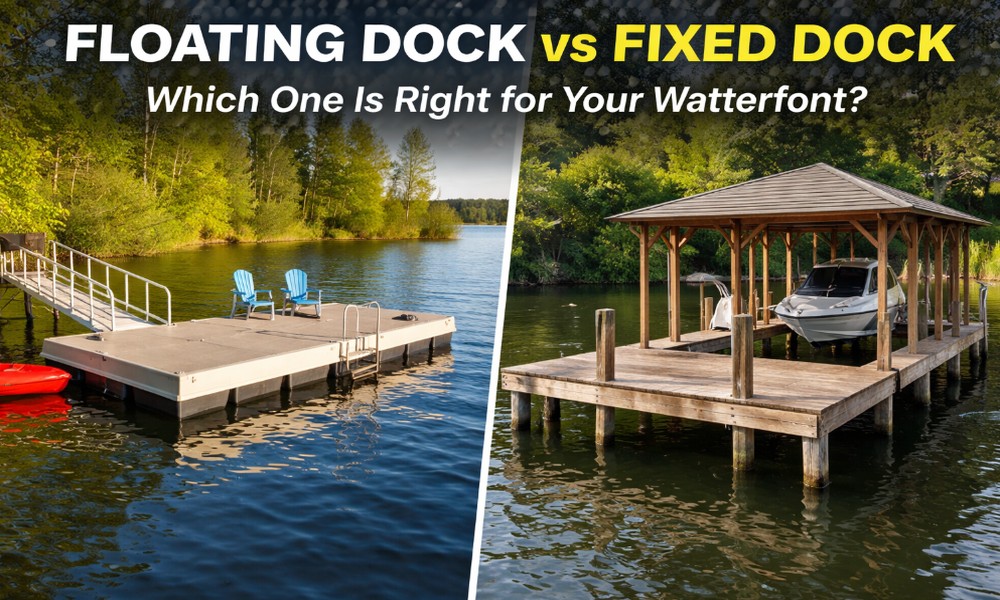
Benefits of floating include: it adjusts to the water’s level, easy access for shifting tides It is also often easier to install and modular expansions are a breeze.
Pros and cons of floating motion underfoot requires a solid anchor, certain materials vibrate or stretch, and some rules still apply.
Fixed has a solid feel, classic design ideal for water stability and big point loads. Con con of fixed: elevation may be difficult when there is low water, construction may take longer, and repairs may require cranes or barges.
How Does Floating Dock Vs Fixed Dock Cost Compare Once You Include The “Hidden Stuff”?
Price on the sticker is just a tiny only a small portion of the tale. In a lot of canals that are residential and marinas the soft soils or the deeper water can push piling numbers up, causing them to cause a tilt towards fixed vs floating floating on project costs. For lakes that have easy access and shallow, firm bottoms Fixed can be competitive. You can also add lifecycle elements. Componentized and swappable floats as well as components in frames makes upgrade feel as if it’s maintenance not a complete rebuild.
What Does Floating Dock Vs Fixed Dock Maintenance Look Like Over Five Years?
Floating can be a win on routine because of hardware, modules and bumpers are easily accessible. Replace a cleat, switch an float, or re-pin an e-pin, continue. Fixed structures require regular inspections of the decking, hardware as well as occasional barge or diver support when the substructure component decides to call to quit. The size of your crew’s capacity is crucial in this regard. If you are looking for regular, quick touch-ups, floating vs fixed leans towards floating. If you are looking for long, quiet periods with rare but more significant maintenance fixed is a natural choice.
How Does Floating Dock Vs Fixed Dock Durability Stack Up In Real Weather?
Durability is a matter of material, detail and water body’s behaviour. Aluminum frames that have quality floating structures can stand up to the abuse provided the anchoring is properly specified. Composite decking or pressure-treated decking can last longer than hurried installations all week long. Fixed docks are able to live for a long time, in peace in coves that are protected, absolutely but the effects of high fetch, ice, and boat wakes are a threat to any structure. The issue isn’t just “which is more sturdy,” it is “which is able to handle the stress you encounter more effectively.” This is the place Floating or fixed docks become an individual decision and not a general one.
Best Dock For Fluctuating Water Levels — Which Option Forgives The Most Mistakes?
It is afloat, the majority of the time. If the water moves upwards or downwards it is still at the same point to the water. The convenience adds up over the course of a season. Fixed may work in the event that you plan your landings, stairs or gangways appropriately however, every foot of swing requires planning. For strong river drawdowns or deltas that are tidal, Floating is more likely to be floating to make it easier for you to use your equipment day-to-day.
Best Dock For Rough Water And Wakes — Who Holds Form When The Wind Gets Loud?
Harbors that are protected are just one of the stories. Open fetch, with wake on weekends traffic is a different story. It is possible to design floating so that it will feel more unified with the correct anchoring, hinge strategy and layouts that reduce waves. Heavier modules help. Fixed may feel planted and secure, however, every time you hit, energy is released. In rough conditions winning often comes from tuning and not the team colors. I favor floating when waves are sharp but stable and anchoring is not always too crowded. If waves and storm surge pile up and float, Floating vs Fixed requires the use of a secure anchor and freeboard discussion.
Hybrid Dock Vs Floating Dock — When Does The Combo Beat A Single System?
Hybrids connect the fixed headwalk to a floating fingers or platform. You will get the level of stability you’re looking for, followed by water-level forgiving where you board. If you’re a bit split about Floating and Fixed Hybrids can resolve the debate without forcing you to join one side. Hybrids are ideal for diverse fleets ADA accessibility targets as well as sites that witness peaceful weekdays as well as raucous holiday traffic.
How Good Is Floating Dock Stability In Waves And What Actually Controls It?
Three factors determine the often: the dimensions and weight of the unit, freeboard height and the layout for anchoring. Wider modules feel calmer. A greater mass can ward off twitchy motion. A board that is in line with your vessel’s type decreases the risk of slipping as you board. Then, anchoring. The length of the chain, its angle and layout patterns can be slowed significantly. A neat triangle that has the proper scope will feel more night and day then two straight lines running to the shore.
Fixed Dock Pilings Vs Floating Dock Anchoring — What Matters More At Your Site?
Pilings form the foundation of the fixed system. Spacing, embedment, as well as the species of steel determine stiffness and longevity. Anchoring is the genesis of floating systems. When you make a mistake in the scope, even the best floats will drift. If you do it right, the surface appears solid. If the bottom of your deck is soft or uneven Deadmen or helical anchors could be able to beat driven piles. The bottom of the pit is mapped. Find the the distance to fetch. Log boat traffic. This homework is Floating and Fixed an algebraic problem, not an assumption.
Which Dock Lasts Longer, Floating Or Fixed — And How Do You Define “Lasts”?
If “lasts” refers to decades of periodic rebuilds, both could perform the task. If it’s adaptable during owner changes, floating has an advantage since the modules can be reconfigured without the need for the need for heavy equipment. If it’s a matter of having minimal movement of the feet throughout the time you own the space fixed is the way to go. My opinion, however remains Floating vs. Fixed, but it is a matter of personal preference. The most effective choice is one that’s in line with the behavior of water the patterns of usage, as well as your desires for upgrades in the future.
A Short Field Guide You Can Actually Use
Print it or drop it into your notepad app. Go around the site and read to the question loudly.
Water behavior
- What is the most significant seasonal variation in the level you’ve observed, but not calculated?
- Do wakes bounce from seawalls, or are they riprapped nearby?
- Where does debris collect after storms?
Access and use
- Common boarding heights for most important vessels?
- ADA targets or rolling carts on the floor?
- Lighting at night and power runs required?
Bottom conditions
- Sand, muck seams of rock or mixed?
- Anchor options: helical deadman piles, concrete block?
- Depth at mean low waters against storm drawdowns?
Constraints
- You can allow time-limits and timelines you already are aware of?
- Access to construction barges for cranes?
- Budget bands now, versus phase-two in the future?
Answer these questions and the Floating image is sharpened quickly.
Question-Based Mini-Guide For Quick Decisions
Q What is the difference between a floating dock and a fixed dock’s pros and cons of smaller footprints?
A: Floating is a good choice for short installations as well as modular expansion. Fixed offers a strong feeling where traffic is not heavy and water flows smoothly.
Q: How do I compare floating dock cost vs. fixed dock cost in the any future extensions?
A: Consider floating as Lego. Add fingers later on with less disturbance. Fixes to add-ons might require new work windows and piles.
Q: Are there any warnings about floating docks as opposed to regular dock repairs in brackish waters?
A: The type of hardware you choose is important. Use sleeves and fasteners that are corrosion resistant. Cleansing your schedules can do more than you imagine.
Q: In which place does floating dock and fixed dock durability first fail?
A For floating, weak anchoring can show up as tension and a lack of hinge. For fixed, decking and fasteners at splash zones get older the fastest.
Q: What is the best dock to use for the fluctuating levels of water when ADA is important?
A: Floating on the gangway slope well-graded. Create your lowest-case water level, so that slopes are comfortable.
Q: What is the best dock for wakes or rough water that are tied-up frequently?
A: More robust floating modules that have strong corner connections and fenders that allows boats to kiss the same areas.
Q: Hybrid dock vs floating dock for kayak launches?
A: The Hybrid model is gorgeous. Fixed approach and a floating low-freeboard launch. Stable plus easy entry.
Q: How can I ensure floating dock stability during peak traffic times of the holidays?
A: Increase the width of the module Check anchor scope, increase cleat spacing and stagger arrivals, if it is possible.
Q: Fixed dock pilings or fixed docks vs. floating dock anchoring to prevent soft silt?
A. Helical anchors, also known as deadmen to allow floating. For deeper piles fixed or sleeves for chasing refusal without breaking budgets.
A: What type of dock will last longer, fixed or floating in the event that I want to sell it in five years?
A: The flexibility of Floating’s design could be a resale benefit. Fixed’s solid, comfortable feel is also able to be a draw for. Find out your buyer’s profile.
A Few Small Habits That Pay Off
- Take a walk through the system every month. Ten minutes beats big surprises.
- Hotspots for log wakes and directions of the wind after rough days.
- Make sure to tighten your hardware in spring and the end of summer.
- Photograph anchors and connections during low water.
- Store the spare pins and cleats and fenders available. Little spares save weekends.
Why Supreme Floating Docks For Design, Build, And Service
We prefer clear and precise diagrams, clear answers, and installations that can pass an squint test. We’ll map the water bodies, model the load, and recommend an option that is logical in the first day of operation and throughout five years later. If you’re considering floating against Fixed, we’ll demonstrate both options with the same attention to detail and help you decide with no pressure. If the plan is real the construction process is smoother and maintenance will feel less.
Quick FAQ (snippet-friendly)
Does a floating system function on ice in winter?
Sometimes, you can get away with the right approach. Anchoring removal or ice-rated removal could be the right choice.
Can I begin fixed first and then add floating?
Yes. This is the basic idea behind hybrids. Create connections now to avoid having to rework.
Which freeboard should I pick?
The type of vessel and the user height. Smaller boats like the lower freeboard. Larger boats can handle more.
How long will installation take?
Access is the main factor in scheduling. Modules floating on the water move quickly when the staging is near. Fixed needs pile windows.
What are the rules for obtaining permits?
Local and environmental regulations are different. We will help you plan the way before you purchase products.
Ready To Choose?
Bring some photos and a sketch along with your water notes for the season. Supreme Floating Docks will review the behavior of the site with you, cost both tracks, and offer you an outlook on maintenance to ensure that the choice sticks. If the Fixed vs Floating seems like a good fit after this we’ll design an alternative and let the numbers make the final decision. No drama. A dock that is a good fit for your water and how you live there.
This post was written by a professional at Supreme Marine Floating Docks. Supreme Marine Floating Docks is dedicated to providing top-quality floating docks and marine accessories that combine durability, innovation, and superior performance. While we are a new brand, our team brings over 50 years of combined industry experience, making us a trusted name in the marine world. We are passionate about designing and delivering products that meet the highest standards, ensuring reliability and longevity in all marine environments. Whether for residential, commercial, or recreational use, our docks are crafted with precision and care, setting a new benchmark in the industry. At Supreme Marine, we aren’t just floating dock builders Miami-we create lasting solutions.